Problem
Only 21% of patients completed the prescribed two-year treatment, weakening outcomes and physician confidence.
Innovation / Patient adherence
As Project Lead and Service Designer, I led a multidisciplinary team to address a critical business problem: only 21% of patients completed the prescribed two-year treatment. We designed and field-tested communication, support, and product interventions that helped adherence reach 25% after one year.
© 2007 IDEO, D. Klein and G. Wustrak
The brief
Only 21% of patients completed the prescribed two-year treatment, weakening outcomes and physician confidence.
I led the team in designing practical interventions that could help patients stay on treatment.
Patients had to self-inject every day for two years and keep the medication refrigerated, including while traveling.
We aimed for a meaningful 2–3 percentage-point increase. Adherence reached 25% after the first year.
Process
We visited a group of 8 patients twice in 10 days. During that time they lived with early prototypes. We did expert interviews with 2 nurse educators, 2 HCPs, and 1 pharmacist to understand treatment challenges from their perspectives.
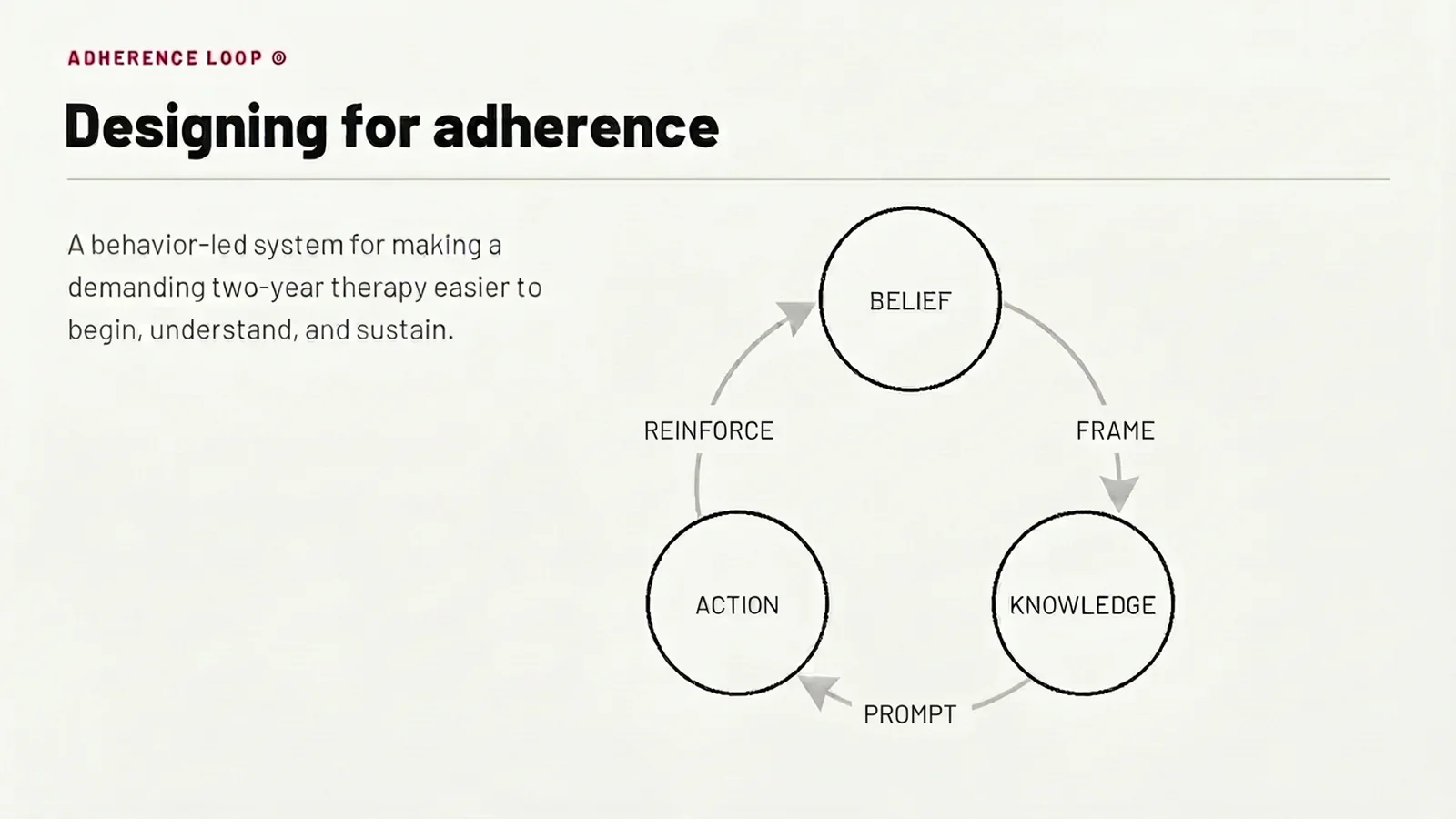
We reframed the adherence challenge into a connected cycle of belief, knowledge, and action rather than simplistic HCP communication or patient reminder problems.
Our team developed interventions aimed at HCPs, caregivers, and patients including: communication tools, call-center scripts, opt-ins, benefit investigation, and physical fridge travel kit design.
The treatment context combined severe osteoporosis, daily self-injection for two years, and continuous refrigeration.
A 21% completion rate defined the adherence challenge and established a 2–3% improvement target.
Visuals, call support, and training materials helped clinicians explain what treatment could achieve.
Eight patients and five clinical participants helped shape three rounds of prototypes through ethnography and in-field iteration.
A redesigned support model addressed insurance, injection training, habit formation, and life after treatment.
A refrigerator-friendly kit organized medication and weekly progress cues around patients’ daily routines.
Adherence reached 25% after one year, then climbed steadily by two percentage points per year through year seven.
Patient feedback described a compact kit that made storage and treatment tracking easier.
Previous case study
Branch Banking Reinvented
Next case study
Urban Driving Innovation